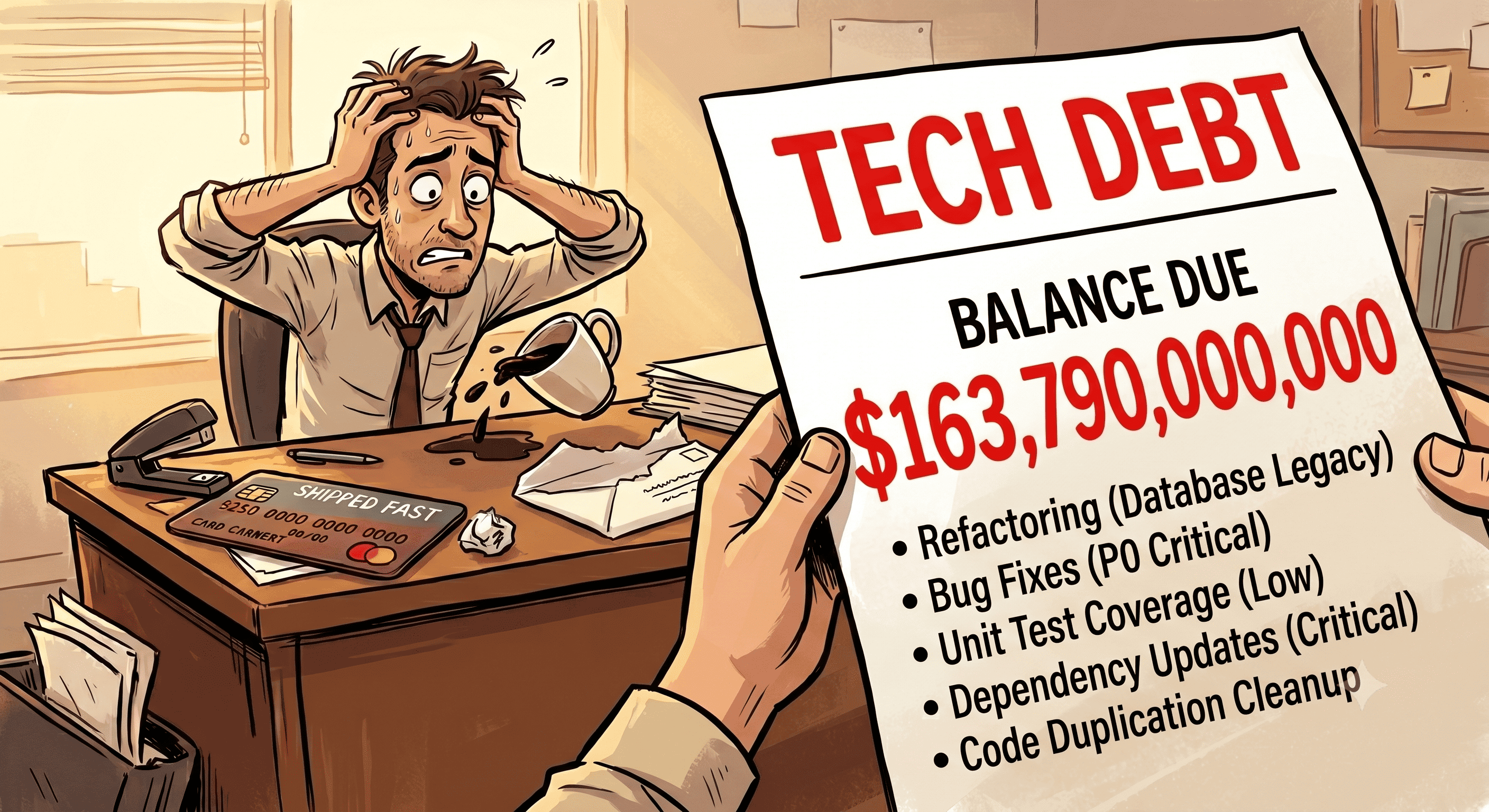

Your software is probably costing you more than you think. Not because of what you built, but because of what you deferred.
If you run a business that depends on software and you don't write code yourself, this concept is one of the most important things you can understand. It affects your budget, your roadmap, your ability to hire, and how fast you can respond to the market.
It's called technical debt. And it's almost certainly accumulating in your codebase right now.
The Credit Card Metaphor
Technical debt works like financial debt. When your team takes a shortcut to ship something faster, they are borrowing against the future. The feature gets out the door today, but the code behind it is harder to work with tomorrow.
Like a credit card, that is not inherently bad. Sometimes it is the right call. You need to launch before a competitor. You need to test a feature with real users before investing in a polished version. You need to hit a deadline that matters to the business.
The problem starts when you stop tracking what you owe.
Interest compounds. What was a quick shortcut six months ago is now a fragile system that breaks every time someone touches it. A change that should take two days takes two weeks because the original shortcut created dependencies nobody planned for.
How It Accumulates
Technical debt does not show up all at once. It builds quietly, usually in one of three ways:
Speed-over-quality tradeoffs in the early build. This is the most common and most understandable form. Your team shipped fast to validate the idea. The code worked, but it was not built to evolve. Now every new feature fights against the foundation.
No one maintaining the codebase after launch. Software does not age like wine. Dependencies get outdated. Security patches pile up. The framework you built on releases breaking changes. If no one is maintaining the system, it is degrading whether you see it or not.
Bolting on features without rethinking the architecture. Your product started as one thing and became another. Each new capability got added on top of the last one without stepping back to ask whether the underlying structure still makes sense. Eventually, the whole thing becomes a tower of compromises.
What It Looks Like From the Outside
You do not need to read code to spot technical debt. Here is what it looks like from a founder perspective:
Simple changes take an unreasonable amount of time. Your team says a small feature will take three weeks, and you cannot understand why.
Bugs keep coming back. You fixed this last month. Why is it broken again?
Your developers keep asking for time to refactor but cannot clearly explain what that means or why it matters.
New features break old ones. Every release introduces new problems somewhere else in the system.
Hiring gets harder. Senior engineers look at the codebase and walk away. Or they join and immediately start talking about how much needs to be rewritten.
If any of this sounds familiar, you are experiencing the interest payments on accumulated technical debt.
When It Matters (and When It Does Not)
Not all technical debt is an emergency. The key question is: how much is it costing you in speed, risk, and opportunity?
Early-stage MVP? Some debt is fine. Expected, even. You are trying to learn, not build a monument. The goal is to validate the idea before investing in production-grade architecture.
Revenue-generating product with real users? Debt becomes business risk. Downtime costs money. Slow feature development means competitors move faster. Security vulnerabilities become liability.
Scaling or entering a regulated market? Debt is now a blocker. You cannot pass a SOC 2 audit with hardcoded credentials. You cannot handle 10x the traffic on an architecture built for a demo.
The tipping point is when debt slows your ability to respond to the market. When your team spends more time working around old problems than building new value, the debt is no longer theoretical.
How to Manage It Without Being Technical
You do not need to understand the code to manage technical debt. You need to ask the right questions and create the right incentives.
Ask your team: "What would break if we kept going at this pace for six more months?" This question surfaces the debt they are already worried about but have not escalated. Listen to what they say.
Budget engineering time for debt reduction. A good rule of thumb is 20% of engineering capacity dedicated to paying down debt, improving infrastructure, and upgrading dependencies. This is not lost productivity. It is maintenance on your most important asset.
Treat it like financial debt. Track it. Prioritize it. Make decisions about which debts to pay down now and which ones you can carry. Your technical leadership should be able to explain the current debt load in terms you understand: risk, cost, and timeline.
Do not let it become invisible. The most dangerous technical debt is the kind nobody talks about. If your team is not flagging debt, it does not mean there is none. It means they have either given up on raising it, or they do not know how to communicate it to you.
The Bottom Line
Technical debt is not a failure. Every codebase has it. Every team creates it. The question is whether you are managing it deliberately or ignoring it until it manages you.
The best technical partners do not just build your software. They flag debt early, communicate it in terms you can act on, and build a plan to keep it under control.
Because the most expensive technical decision you will make is not choosing the wrong framework or the wrong feature. It is letting the shortcuts accumulate until the system cannot support the business anymore.
That is when the real bill comes due.